2.png)
About the Journal
Symbiotic: Journal of Biological Education and Science
(e-ISSN: 2721-8988 p-ISSN: 2721-8600)
Published by: Institut Agama Islam Negeri Kerinci
Pengelola: Fakultas Tarbiyah dan Ilmu Keguruan
In Collaboration with: ADBPB-PTKI
Symbiotic: Journal of Biological Education and Science is a scientific journal published by Biology Department of Faculty of Education and Teacher Training of State Islamic Institute of Kerinci. Since June 2020 this journal collaborates with Asosiasi Dosen Biologi Dan Pendidikan Biologi Perguruan Tinggi Keagamaan Islam (ADBPB-PTKI) (Association of Biological and Educational biology lecturer of Islamic religious colleges).
The aim of the Symbiotic: Journal of Biological Education and Science is to provide an international or National forum for the sharing, dissemination and discussion of research, experience and perspectives across a wide range of Biological Education and Biological Science. This journal is published twice a year in April and October.
Symbiotic: Journal of Biological Education and Science was accreditated in Sinta 4 by The Ministry of Research and Technology and The National Innovation Agency of the Republic of Indonesia from Volume 2 issue 1 (2021) until Volume 6 issue 2 (2025).
Authors should submit only papers that have been carefully proofread and polished. Before submission please make sure that your paper is prepared using the journal paper template.The authors must refer to Symbiotic: Journal of Biological Education and Science for writing format and style (Please download and use as template for initial manuscript submission (Download Template) . This will ensure fast processing and publication. Any papers not fulfilling the requirements based on the guideline to authors will not be processed.
Online Submission
We strongly prefer to receive manuscripts via our online submission system. Using this system, authors can upload manuscript files (text, figures and supplementary information, including video) directly to our office and check on the status of their manuscripts during the review process. First, kindly please register as author, and then you should login to submit your papers. Please don´t forget tick author when you make a registration.
__________________________________________
| Journal title | Symbiotic: Journal of Biological Education and Science |
| Initials | Symbiotic |
| Frequency | 2 issues per year (April & October) |
| DOI | by  |
| Online ISSN | 2721-8988 |
| Print ISSN | 2721-8600 |
| Editor-in-chief | Dharma Ferry, M.Pd |
| Publisher | Institut Agama Islam Negeri Kerinci |
| Cite Analysis | Google Scholar |
Current Issue
Vol. 6 No. 2 (2025): Symbiotic: Journal of Biological Education and Science Vol. 6 No. 2 Oktober 2025
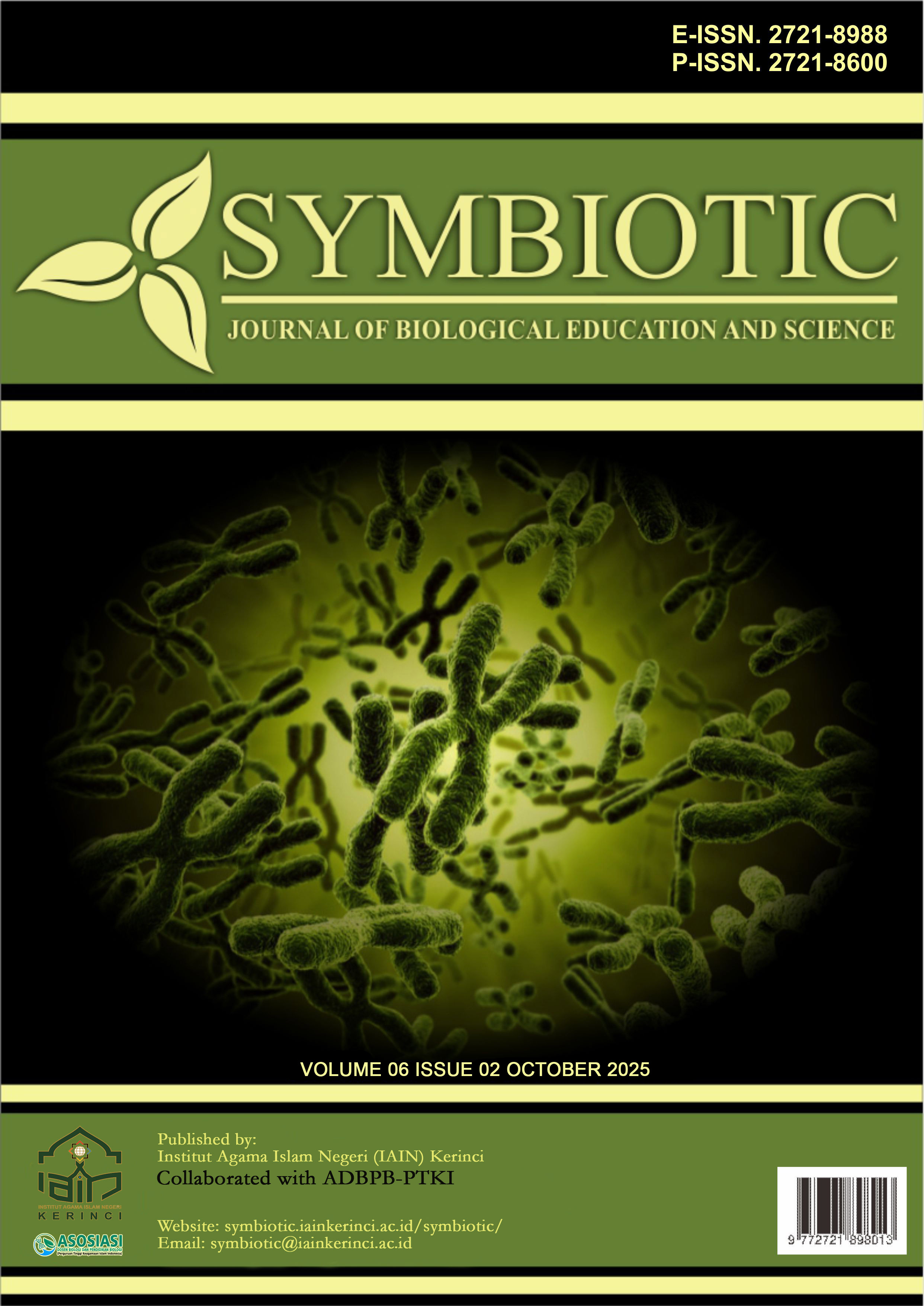
Symbiotic Edition: Journal of Biological Education and Science, Volume 6, Issue 2, October 2025, presents a collection of studies highlighting recent advances and applications in biological sciences and education. The topics span from biodiversity exploration, molecular biology, and biotechnology to innovative learning approaches and environmental sustainability. Research on Physalis angulata maps global scientific trends through bibliometric analysis, while studies on fern and Rubiaceae diversity emphasize the integration of local ecological resources into digital and field-based learning. The role of the EPSPS and TP53 genes is explored within the contexts of herbicide resistance and cancer therapy, respectively, reflecting the growing intersection of molecular genetics and applied biotechnology. Educational innovations such as Wordwall-based game learning and e-magazine media demonstrate the impact of digital tools in improving learning outcomes and creative thinking skills, aligning with the SDGs’ goal of quality education. Environmental-focused articles address the effects of sand mining on aquatic biodiversity and document insect diversity in agricultural ecosystems, reinforcing the importance of conservation and sustainable management. Collectively, these studies provide a comprehensive view of the interconnection between biological research, education, and sustainability, offering valuable insights for advancing scientific literacy, ecological awareness, and technology integration in contemporary biology education.
Published:
2025-10-30
Articles
This journal indexed and/or available catalogue in:











In Collaboration with:
Dedicated to: